A/D-first output
Results say exactly which in-game key to press: A or D.
Guided Mapping
Enter before and after pin positions; the tool detects Same and Opposite links.
Plate image reference
Use the image to match Plate 1, Plate 2, and the rest correctly.
No-mod workflow
Runs locally in your browser. No game files, save edits, or account.
A beginner-friendly lockbreaker alternative
Some lockbreaker tools expect you to already understand the coupling matrix. This page is designed for players who are stuck at a chest and need a clearer A/D walkthrough instead of a manual matrix-first tool.
Start here
New to Gothic Remake lockpicking? Follow these four steps.
- Count the plates and pick that number in step 1.
- Set each current pin position (1-7, where 4 is the center target).
- Test the suggested A or D key on one plate, then enter the after positions.
- Repeat for every plate, then press Solve.
Loads a solvable 5-plate example so you can see the A/D output right away.
In-game controls
- A = move the selected plate left
- D = move the selected plate right
- W / S = select another plate
- Save before each mapping test
We show keys, not visual pin direction.
0 Plate numbering reference
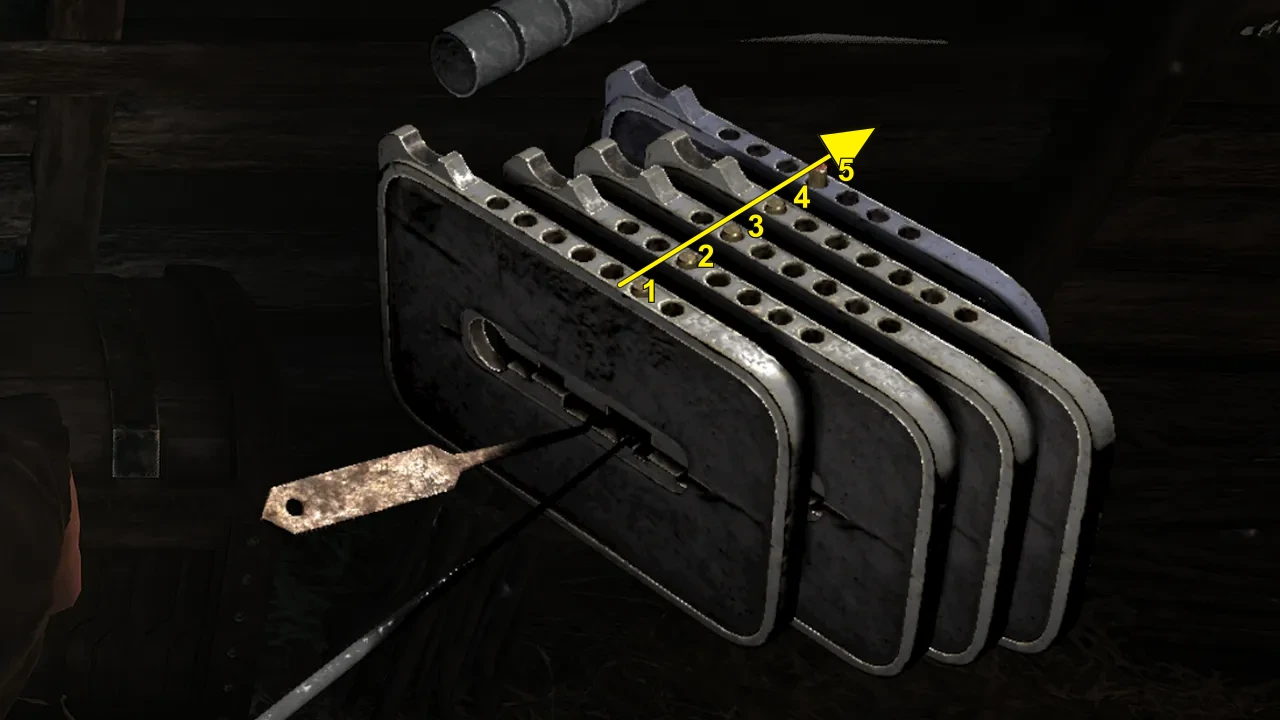
Reverse Plate Numbering switches the image and plate labels to match references that start from the inner/back plate. Click again to return to the default outer-to-inner order.
1 What do you see?
Supports 3–7 plates. Most Gothic Remake lockpicking puzzles appear to use 4–7. Each plate has 7 pin positions; position 4 is the center target.
Default path: use Guided Mapping below. If you already know the lock matrix, switch to Expert Matrix in step 3.
2 Current pin positions
Click each plate's current pin position from 1 to 7. Position 4 is the center target. The UI uses 1–7; the algorithm internally converts them to -3..+3.
3 Map plate interactions
Choose one setup path. Guided Mapping is recommended; Expert Matrix is only for locks where you already know Same, Opp., or Gone links.
3A Guided Mapping
Follow the current plate only: save or reload, press one A/D key once, record the after positions, then map that plate. When every row is mapped, continue to step 4.
3A. Test one plate
3B. After one key press
Enter what the lock looks like after that single key press. Do not solve yet; this only maps one row.
4 Safe A/D solution
When every plate is mapped, solve produces the in-game A/D sequence. Copy the steps or create a share link for Discord, Reddit, Steam, or a friend.
Lockbreaker vs lock solver
Lockbreaker search intent
Players searching lockbreaker often want the lock solved quickly. This tool still asks for visible data, but Guided Mapping removes most of the guesswork.
Why the output is A/D
The final answer is written as in-game key presses, not abstract directions. That makes it easier to follow while the lock is on screen.
What makes this different from a matrix-only tool
The page keeps the same solver engine but explains it through the lockbreaker alternative search intent. It is meant for players who want an answer path, not a spreadsheet of relations.
When the solver says no solution
- Check the plate numbering and try the reverse order.
- Make sure every plate row is mapped, not skipped.
- Re-test the plate that caused an edge break.
- Switch to Expert Matrix only if you already know the coupling.
- Try Easy Fast mode if the lock has 7 plates.
FAQ
How is this different from an ordinary lockbreaker tool?
Most lockbreakers assume you already know the Same/Opposite matrix. Guided Mapping detects those links for you from before and after positions, so beginners can use it too.
Do I need to know the coupling matrix to use this?
No. Use Guided Mapping and the tool infers each plate link. Expert Matrix is optional and only there for players who already know the relations.
Will it break my lockpicks?
The solver rejects any move that would push a pin past position 1 or 7, so every step it returns is edge-safe.
Do I need to test both A and D for each plate?
No. One safe key test is enough for each plate. If the recommended key is unsafe at an edge, reload and test the opposite key for that same plate.
What do Same, Opp., and Gone mean?
Same means the affected plate follows the same key effect. Opp. means it moves the opposite way. Gone marks a removed link and is treated as no effect.
Fan-made tool. Not affiliated with, endorsed by, or sponsored by Alkimia Interactive, THQ Nordic, or the Gothic Remake development team.
Related tools
Use a focused page when the search wording changes.